
Economy still growing, data center construction driving growth, economist says
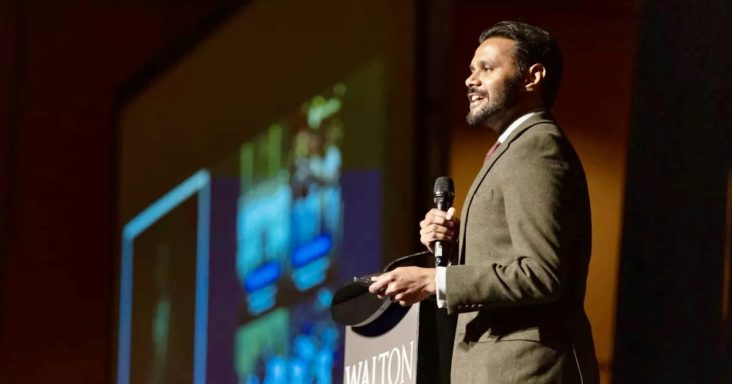
Mervin Jebaraj, director of the Center for Business and Economic Research in the Sam M. Walton College of Business at the University of Arkansas
Data centers are driving U.S. business investment, inflation is up because of energy prices, and consumer sentiment is down to a level lower than during the Great Recession, a University of Arkansas economist said.
Mervin Jebaraj, director of the Center for Business and Economic Research in the Sam M. Walton College of Business at the University of Arkansas, provided an overview and outlook of the U.S., state and area economy at the Quarterly Business Analysis Luncheon on Thursday (June 4) in Fayetteville. Jebaraj spoke to a large gathering of residents, including leaders of area businesses and organizations.
Jebaraj said the U.S. economy is still growing and expects second-quarter GDP growth of 2.5% to 3%, which is better than the first-quarter growth. Much of the growth from 2025 to 2026 can be attributed to business investment in data centers amid the rise of artificial intelligence (AI). In the last quarter, about $50 billion was invested in new data centers in the United States.
“That’s a lot of money,” Jebaraj said. “That’s just the building. That does not include any of the equipment… that’s going into them. So, at this point, the U.S. economy has always been mostly consumers and then businesses… the fast growth piece is not coming from you and I going out and spending a lot of money. It’s coming from data center construction and all the investment in artificial intelligence.”
Jebaraj said U.S. employment is growing, but the growth has moderated over the past five years. In periods of slower growth, one-time events such as weather impacts, strikes, or a government shutdown could have a greater effect on monthly numbers and lead to a decline in monthly employment.
“That doesn’t mean the economy is slow,” he said. “It just means that our…new balance level is so low that these one-off events can often push the employment picture down here.”
Job openings are up, but the data shows no one is hiring and no one is quitting their jobs.
“So it’s the no-hire, no-quit, no-fire economy,” he said. “At this point, their jobs basically resemble a hostage situation with health insurance. They’re just staying for a prolonged period of time. They’re not leaving anywhere. And that is unlikely to change.”
The unemployment rates for the United States, Arkansas and Northwest Arkansas all rose over the past year. The state and national unemployment rates are similar, under 4.5%, while Northwest Arkansas’ rate is under 3.5%.
“If you told me 10 years ago that 4.3% unemployment rate was high, I would have laughed at you because our normal 10 years ago used to be about 6%,” Jebaraj said. “It’s just that we’ve gotten used to 3.5% for so long that 4.5% feels a lot higher.”
In Arkansas, employment in the leisure and hospitality sector is rising the fastest, up 2.1% from 2025 to 2026. Other growing sectors include healthcare and professional and business services. Most of that growth is in Northwest Arkansas. Construction sector employment in Arkansas is down 1.7%. Jebaraj attributed this partly to federal programs and highway transportation bills that had funded much of the construction. Most of that money is spent, and no new money is expected, he said.
In Northwest Arkansas, employment in the leisure and hospitality sector is also rising the fastest, with growth of 8.2% from 2025 to 2026. Other growing sectors include professional and business services, construction and government.
Jebaraj said the U.S. labor force participation rate is down because of the high number of retirees. The data shows that for those between 25 and 54 years old, the “rate is pretty much at the peak level… So people that are in their prime employment years are basically all at work.”
Looking at the data for those 16 to 64, the numbers are down because teenagers don’t have jobs as much anymore, he said. Jebaraj also discussed how AI has and might impact the job market. There’s a lot of uncertainty in the market, but he attributed economic volatility to the recent slight increase in the unemployment rate for college graduates with bachelor’s degrees.
“There was a lot of things happening in 2025 that made businesses pause,” he said. “And it wasn’t just artificial intelligence, although that might have been what they said. We want to wait and see.”
AI IMPACT SCENARIOS
More recently, the unemployment rate has declined faster among college graduates with bachelor’s degrees than among those without bachelor’s degrees. Jebaraj said one theory on how AI might impact the job market is that if it makes a job easier and faster, it should reduce the price. And if the price of that service falls, more people will consume it. As a result, it might boost employment.
He said if AI makes jobs easier to do, demand for those services will rise because the prices will fall. The overall volume of work will rise, and the employment “is probably not affected.” However, he said that the job losses attributed to AI might not have occurred yet. He said a jobs correction due to new technologies might not take place until a recession happens.
“So everything I said before could be wrong,” he added. “And, you know, we might be looking at this instead, although I don’t necessarily always buy that. I think the first case I made is more likely than this case.”
CONSUMER SPENDING, SENTIMENT
Jebaraj said the amount of money U.S. consumers are spending is still increasing, but the growth has moderated. He attributed this to the recent increase in gas prices. People are spending money on gas but less on other items than they used to.
“So we’ve seen a big inflation spike in the last couple of months, entirely because of energy prices, which means that the wages adjusted for inflation is basically flat or going down at this point,” he said. “It’s the first decline that we’ve had in a long period of time.”
Jebaraj showed a chart of the University of Michigan consumer sentiment index that showed consumer sentiment has fallen to levels lower than during the Great Recession from 2007 to 2009.
“And you can just see that people are sad,” Jebaraj said. “I don’t know why… Is sentiment really that bad at this point?”
The sentiment helps to predict consumer spending, “except that we’ve been sad for a while… and we’re still going out and spending money. So maybe we should ignore this a little bit…
“Partly, some of the explanation for why we’re sad is because, you know, when we look at consumer sentiment, people with lower incomes have lower consumer sentiment, which makes sense. People with middle incomes have slightly higher consumer sentiment than them. People with higher incomes have even higher consumer sentiment than people with middle-level incomes and lower incomes.”
Before the pandemic, people with higher incomes had consumer sentiment about 20% higher than that of people with lower incomes. Since then, that’s narrowed to the single digits. He said this makes “little sense” because those with higher incomes still have higher incomes and spend their money. One theory is that services inflation has been persistent since the pandemic. The cost of services that higher-income households are paying for has risen since then. He attributed some of the services inflation to the wage increases that workers received after the pandemic.
“There’s really no way to fix this unless you want to find people that are willing to work for lower wages, which as we all know, is very hard to do,” he said. “So that piece is probably not going away anywhere too soon.”
INFLATION, MORTGAGE RATES
With the inflation rate remaining above the Fed’s 2% target, the market is projecting a 50% chance for a rate hike in the federal funds rate this year. Jebaraj said mortgage rates are tied to the 10-year Treasury yield, which has been rising in recent weeks. He said economic volatility and rising mortgage rates are dampening growth in home construction. People are remaining in their homes longer.
“This might be another reason why people aren’t happy,” he said. “They’re just stuck in their same home, so they’re renovating their homes.”
Still in Northwest Arkansas, home sales continue to rise, and inventory remains low. Prices in the area are also increasing by mid-single digits. Multifamily vacancy rates have risen to over 5% as several apartment complexes have recently opened. He said that area apartment complexes have taken about a year to fall to a vacancy rate of less than 5%. While they are filling up, it takes about three to six months longer than it used to. Rents also continue to rise.
“People are signing a new lease at their new apartment,” he said. “They’re getting a lot of incentives, especially the brand new ones that come online because they want to get them occupied as quickly as possible… probably because they want to sell it to somebody else… So you’re not seeing a huge decrease in the rents because of that.”
Link here for a PDF of the report presented by Jebaraj.