
Rice plants and Venus flytraps have unexpectedly similar defense systems
by May 18, 2026 2:27 pm 168 views
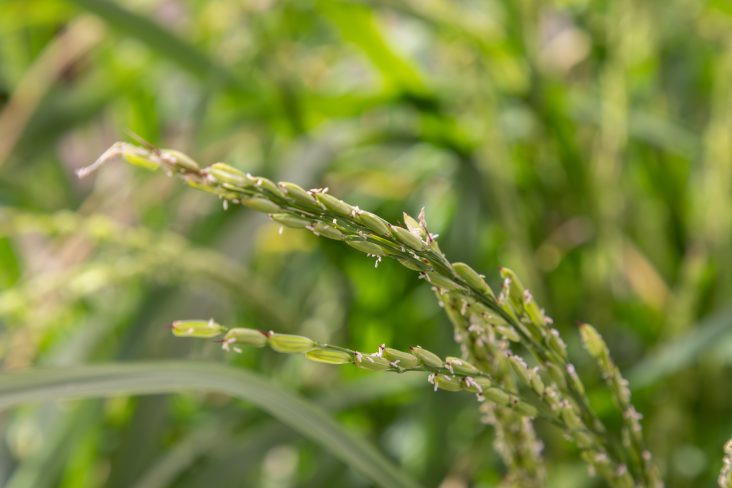
A routine observation by a scientist may have led to a significant discovery about plant defense systems.
Using a faint smell to lure caterpillars into a trap, rice plants kill early-stage fall armyworm larvae by trapping them in a spikelet, the part at the end of a rice panicle where individual grains develop. Venus flytraps use a similar method.
In its flowering stage, the spikelet opens to expose a floret for pollination. Covered in spike-like hairs called trichomes, the spikelet slowly closes on the caterpillar stuck on the barbs.
The observation that led to the finding was unexpected for Dr. Devi Balakrishnan.
“This was not in the plan,” said Balakrishnan, a member of the department of entomology and plant pathology for the Arkansas Agricultural Experiment Station. “I was doing another experiment on rice with fall armyworms and started noticing these caterpillars were inside the spikelet, and they were dead.”
To figure out why and how many fall armyworms were getting trapped by rice spikelets, Balakrishnan conducted four different replication trials under the advisement of Rupesh Kariyat, an associate professor.
The four complementary experiments showed that roughly 50% of the fall armyworm caterpillars, which were about a week old, were trapped and died in rice spikelets while attempting to feed on florets. The results were the same when the researchers placed rice leaves in the enclosure. About half of them died within 48 hours when trying to feed on the floret inside the spikelet.
A third experiment tested whether floral volatiles could guide fall armyworm caterpillars to the panicle. They found that the caterpillars showed a slight preference for panicles with floret-bearing spikelets rather than those at the dough stage, a later phase when the spikelet has closed to allow further development of the rice grain.
The findings provide preliminary evidence that spikelet trichomes may function as a defense mechanism against herbivores feeding on reproductive structures, the study states.
“This is a proof of concept,” Kariyat said. “One of the things we still want to ask is if it is a combination of the smell of flowers, the trichomes and individual components in the flower and the species of rice.”
The experiments used a wild-type rice. While rice originated in Asia, the fall armyworm is native to North America and has become an invasive species in many other parts of the world, Balakrishnan said. Future studies could examine which other kinds of caterpillars, and at what growth stage, can also become trapped in a rice spikelet. Larger caterpillars that have developed mandibles may be able to chew out of the tight spot.
Since the researchers collected and analyzed the smell emitted by the flower that potentially lures the caterpillar, Kariyat said they would like to see if increasing the amount of that smell in a spray could help attract and trap more caterpillars in the rice spikelets. Creation of a natural chemical compound to spray on rice plants during the flower stage could serve as a pest-control strategy.
“Rice is a very defensive plant, which we don’t typically say about rice … we don’t associate it with toxic plants,” Kariyat said. “But we think fall armyworms get enticed, because the floral scent basically tells the caterpillar there is better food here. We speculate that these volatiles might be responsible for the attraction of fall armyworms towards florets, which then get trapped by the trichomes.”
Rice is also the staple cereal for about half of the world’s population, and the fall armyworm is emerging as a serious threat amid growing resistance to dozens of insecticides. The research provides important insights into a key plant-insect interaction that may offer alternative or complementary control strategies in the future.
Balakrishnan initially set out to study whether a protein kinase involved in plant signaling could help rice tolerate stress. To do that, she used fall armyworm caterpillars as a biological test, examining the role of SnRK1 — shorthand for sucrose non-fermenting–related kinases — during the rice plant’s flowering stage.
After 48 hours in an enclosure, the second-instar caterpillars had migrated from the leaves to the panicles.
“There are studies showing fall armyworms can feed on panicles, so I assumed that’s what they were doing,” Balakrishnan said. “But when I looked more closely, they weren’t feeding at all. They were dead inside the spikelet — and not just one or two. It was happening a lot.”
Arkansas is the leading producer of rice in the country with roughly half the nation’s crop grown here. The state is projected to have about 1 million acres planted this year.