
Congress for the New Urbanism speaker touts the technology of playgrounds
by May 15, 2026 8:00 pm 488 views
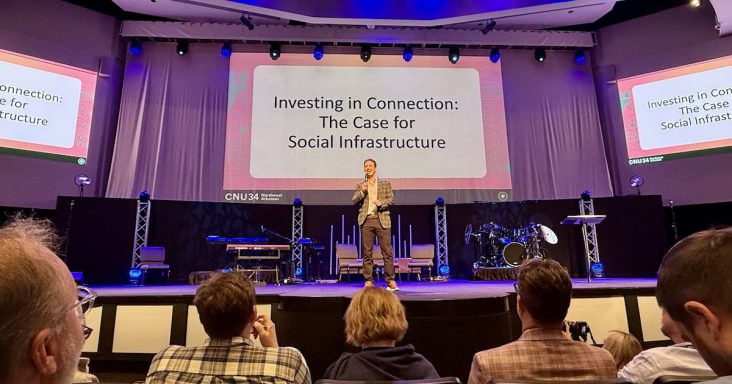
Scholar and sociologist Eric Klinenberg speaks in Bentonville on Friday (May 15) at the 34th Congress for the New Urbanism.
Scholar and sociologist Eric Klinenberg stressed the importance of the spaces and places where people meet and interact as a new concept for infrastructure that cities often prioritize less in their capital investment planning.
Klinenberg of New York provided the closing keynote Friday (May 15) at the 34th Congress for the New Urbanism (CNU 34), its annual gathering of leaders in urban design, planning and housing.
About 1,300 people, including architects, urban planners and real estate executives from across the United States, North America and Europe, attended the five-day event hosted at venues in Bentonville and Fayetteville. It’s CNU’s first congress in Arkansas. The Washington, D.C.-based nonprofit is dedicated to creating walkable, sustainable and inclusive communities worldwide.
Klinenberg is an author, sociologist and Helen Gould Shepard Professor of Social Science and director of the Institute for Public Knowledge at New York University. His newest book, “2020,” tells the stories of New Yorkers’ experiences during the first year of the COVID-19 pandemic. He previously wrote “Palaces for the People,” which suggests that social infrastructure, or the places and organizations where people interact, is key to building a democracy that works for everyone.
A Chicago native, Klinenberg lives in Manhattan and previously visited Northwest Arkansas when he spoke in Fayetteville. He said he’s writing a new book on social infrastructure, which he hopes to release early next year.
Several months ago, he flew to Germany as part of an advisory board for a wealthy family interested in technology. The aim was to determine the technology “that is most likely to help us rebuild a sense of cohesion and strengthen our communities,” he said. The board members shared various technologies, and Klinenberg suggested the playground when asked what technology “would be most helpful for bolstering communities in cities and communities of all sizes.”
“A playground is a really important thing in a neighborhood and in a community,” he said. “And I don’t think we appreciate what an incredible technology it is.”
He said for families who live within walking distance of a playground, it’s “transformative… And it’s not just transformative because it helps you get out of the house and is a release for your kids who are bouncing off the walls… One of the principal ways that kids learn to participate in community life and also to participate in civic and democratic life is by playing with each other on playgrounds.”
The playground is also where parents can interact with other parents to learn about their community, such as which pediatricians, babysitters and schools are good.
“Friendships are forged,” he said. “And the friendships turn into communities.”
Growing up in Chicago, he said, there was a lot of “good social infrastructure” but no budget to maintain it. He said not enough communities do so.
He said the playground is one example of social infrastructure or physical infrastructure for social life. “It’s not just like a cool set of words. It’s an actual, physical thing…
“And what I have shown in my work over decades is that if you invest in social infrastructure, if you design it well, if you build it well, if you maintain it, and if you program it, you get all kinds of returns to your social and your civic life.”
Klinenberg said the concept of social infrastructure is new, as most conversations about infrastructure have focused on other things, such as electric, communications or transportation infrastructure. Some of his favorite types of social infrastructure include parks, libraries and community gardens.
“If we don’t invest in social infrastructure, we become more likely to hunker down,” he said. “We find connection in our private life. We find it in our phones. We might find it in private social spaces where we don’t encounter the range of people we need to encounter to live in a strong democracy.”
He said people affiliated with differing political parties sometimes “don’t know how to talk to each other. And I think one of the things about social infrastructure that is so powerful is that it can provide a forum in which people can interact in a more regular way and start to slowly break down the divisions that, at the moment at least, have us thinking of each other as enemies, which is not sustainable.”
Cities, however, tend to place a lower priority on social infrastructure investments, resulting in little to no funding in city budgets. He added that when cities plan their budgets, they don’t prioritize a healthy civil society, an open democratic culture, or addressing social disconnection, and promote cohesion.
Klinenberg became involved in social infrastructure research while working on his first book about a heat wave in Chicago. He learned that the parts of the city with fewer deaths had more robust social infrastructure, walkable sidewalks, a culture where people sat on their stoops, community organizations, religious institutions, a library and diners.
He said those residents were drawn out of their homes and regularly interacted with people around them. During the heat wave, if someone regularly seen on the stoop is no longer there, a neighbor might knock on the door to check on the person.
Klinenberg explained that social infrastructure could also be used to help with flooding, especially as heavy rainfall in short periods has become more prevalent in New York and other parts of the country. Existing infrastructure can no longer handle this level of flooding.
He said the temptation is to “tear up every street and replace the pipes, including new pumps… Imagine what it would take to rebuild the hardscape, sewage piping, and pump system of every block in every city in every country in every continent on Earth — like the trillions of dollars, the decades of time. Like, it’s not going to happen.”
His idea is a sponge city. He said existing hardscape systems need to be updated, “but we also have to create a new world of softscapes, parks, play spaces and community gardens. We need to soften the landscape, and we need to capture more water. We need to slow down the flow of water so that it doesn’t overwhelm the sewage system when it comes in because you really don’t want your sewage system backing up… The best way to do that turns out to be making a massive investment in social infrastructure.”
CNU 34 ends Saturday (May 16) with an open house that includes multiple speakers and panels between 8:30 a.m. and 4:30 p.m. at Fayetteville Town Center. CNU 35 will be hosted June 15-18, 2027, in the Minneapolis and St. Paul metro area.