
Arkansas Agricultural Experiment Station to deploy statewide network of weather stations
by February 11, 2026 8:22 pm 577 views
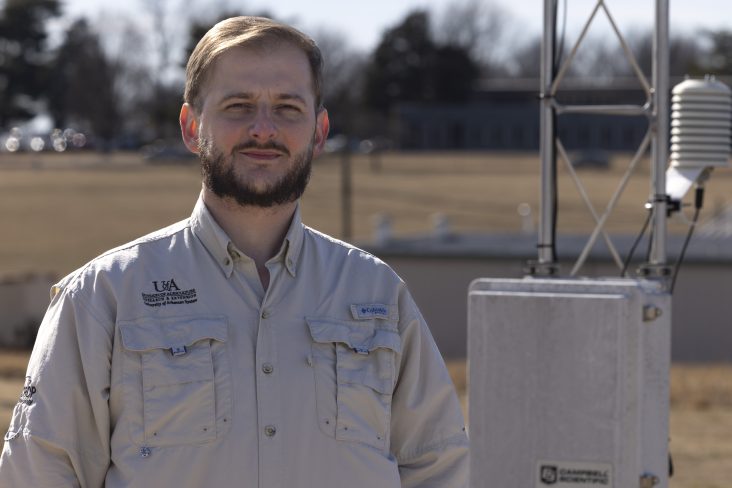
Arkansas has some of the most varied weather and terrain in the country. Weather events have dramatically different impacts across the state and it affects farmers each year. The Arkansas Agricultural Experiment Station is set to deploy new tools to collect weather-related data.
A $425,000 grant from the U.S. Department of Agriculture’s National Institute of Food and Agriculture is being used to build 20 weather stations statewide. The project is slated to be completed later this year. Site locations for the weather stations are being determined at the research and extension centers across the state along with participants in the Arkansas Discovery Farms program.
Data from the weather stations will be publicly available on the University of Arkansas System Division of Agriculture website at at weatherstation.uada.edu. The experiment station is the research arm of the Division of Agriculture.
“Our goal is to make high-quality weather data available to our researchers and beyond,” said Elvis Elli, project coordinator and an assistant professor of crop physiology in the department of crop, soil and environmental sciences. “Having the networked weather stations where most of the research is done will give everyone access to the same high-quality, standardized weather measurements across the state.”
Each Division of Agriculture research and extension center currently has some form of weather recording equipment, but the new stations will create a standard system across all locations, provide additional data points, and make multi-site trials easier to conduct, Elli added.
The Campbell Scientific UT30 weather station was selected for the project. The stations will stand about 30 feet tall atop a concrete base and will come with network-enabled measurement and control dataloggers.
The weather stations will be powered by a local source or solar power and hourly record air temperature at three heights, relative humidity, solar radiation, photosynthetically active radiation, wind speed and direction, soil temperature and moisture at two depths, rainfall and leaf wetness.
Weather data is used for many things in agricultural research, including irrigation management, crop modeling and physiology carbon cycle studies, and forecasting to manage pests, weeds and pathogens. Other uses include research on extreme weather events and water quality, as well as tying remote-sensing data from satellites to local conditions.
Karen Watts DiCicco, the chief information security officer and director of business enablement and enterprise applications for the Division of Agriculture, will oversee the application development team as a collaborator on the weather station project. As each new station goes live, DiCicco’s team will add its information to the site so everyone can view the data in one place, she said.
Mary Savin, professor and head of the department of horticulture for the Division of Agriculture and the Dale Bumpers College of Agricultural, Food and Life Sciences, initiated the weather station project several years ago and is also a collaborator on the current project, which she says will benefit research in a wide range of academic disciplines.
“I am very excited that Dr. Elli and a multitude of colleagues have had the support of UADA administration and have successfully pursued federal grant funding to enhance Arkansas’ weather data collection and data management capabilities,” Savin said.
Over the years, as a faculty member and then an assistant director for the experiment station, Savin said she heard from researchers across many disciplines that reliably obtaining consistent and complete weather data throughout the state of Arkansas has been an ongoing challenge.
“Researchers have been limited by a lack of robust, networked weather stations with easily downloadable data,” Savin said. “This grant is an excellent example of an award that will support many of UADA’s departments and their land-grant mission for the benefit of stakeholders throughout Arkansas’ communities and industries.
“Field equipment that will be installed throughout the state, along with data and web management infrastructure, will facilitate access to data to support new knowledge and facilitate better decision-making for the management of our natural ecosystems. This project also opens opportunities for education and development of the workforce in Arkansas to be better problem-solvers to address complex issues confronting the state.”