
Whole-body MRI center to open in Pinnacle Hills area
by November 9, 2025 10:01 am 1,324 views
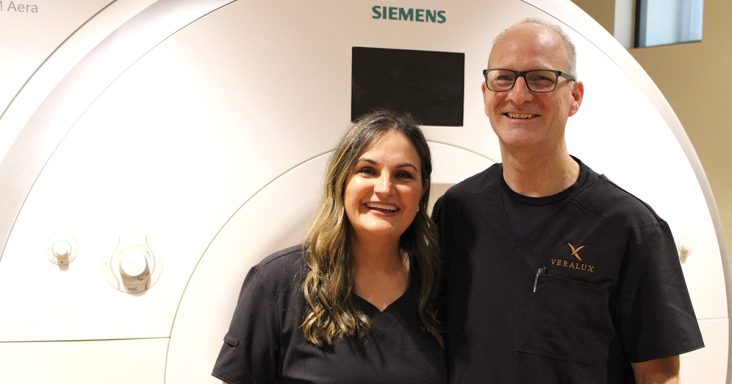
Drs. Vanessa Hardin Branch and Drake Branch are the co-founders of Veralux.
Veralux, the state’s first dedicated whole-body MRI center, is set to open this month in the Pinnacle Hills area of Rogers. The 2,241-square-foot clinic at 2000 S. 42nd St., Suite 120, will begin seeing patients Nov. 17. Grand opening is Jan. 22.
Drs. Vanessa Hardin Branch and Drake Branch co-founded Veralux and are investing over $2 million into the center, including $1.3 million for the new Siemens MRI machine. The two doctors married in 2006 and moved to Northwest Arkansas 13 years ago when their daughter was 2 weeks old. Drake is a pathologist at Northwest Arkansas Pathology Associates in Fayetteville, and Vanessa is a neuroradiologist with Medical Associates of Northwest Arkansas (MANA) Imaging in Fayetteville.
Vanessa will work there through the end of the year, and Drake will remain at Northwest Arkansas Pathology Associates.
“This is really Vanessa’s baby,” Drake said. “We’re both committed, and … we’re both very passionate about this service and bringing it to Northwest Arkansas.”
Vanessa’s worked in radiology at MANA for 13 years, and “in that time, I read for a busy oncology group,” she said. “I’ve seen cancer every day multiple times a day, and in my own personal experience, I’ve had family members who, for instance, a very close cousin of mine who’s young — I consider 50 young. He was super healthy — physical trainer, didn’t smoke, didn’t drink, ate right, did everything right — and one day he was found to have a nearly 10-centimeter kidney cancer out of the blue.
 “And that shocked me, and it should. You see a lot of cancer every day, but when it starts to come and affect you at home, it starts to really change your mind.”
Then, her mother had a 10-millimeter aneurysm, “which sounds small, but actually that’s very large for an intracranial aneurysm,” she said. Another family member has multiple sclerosis. “And things like this kept occurring.”
She and Drake discussed being “able to catch these things earlier. We should be able to proactively detect them and be able to have a fighting chance.”
“Preventive medicine has been around forever,” she said. “But as far as preventive imaging, that’s more recent — I call it modern medicine or medicine 3.0.”
The rise of advanced imaging technology has contributed to an increase in preventive imaging.
“What you can do is noninvasively detect cancer, aneurysms, inflammatory conditions like multiple sclerosis … a host of things that could potentially cause a bad outcome,” Vanessa said.
Veralux’s MRI uses artificial intelligence to increase the speed and quality of the radiation-free screening, she said. Screenings range from $999 for a torso scan to $2,499 for a whole-body scan.
UNIQUE CENTER
Vanessa said the nearest MRI center, like Veralux, would be in a large city such as Dallas.
“Our model is different in terms of we wanted to have something local,” she said. “I know a lot of clinicians. I have established the relationships, and I want to take care of Arkansans.”
This part of the heartland sometimes doesn’t have easy access to care like this. “So I wanted to be able to provide that access for our neck of the woods,” she said.
Veralux’s screenings are only for preventive care. This would be for someone with a family history of cancer or health advocates who want to know what’s “literally inside their body and how their body is composed,” Vanessa said. “We can analyze body composition. That’s a health metric that looks at the distribution of fat, either subcutaneous or visceral, which is more dangerous around the organs. It can also look at your amount of muscle mass. And you can risk-stratify based on those metrics, and that’s something I’m really passionate about.”
This can help those looking “to optimize their health,” she said. “For health span and life span purposes, we want to know what’s my metabolic status, and you can detect that secondarily through liver fat and things like that in the body.”
Vanessa said her approach to preventing screening isn’t about fear but proactivity and empowerment “so that we have awareness, we have clarity, we understand what we’re dealing with, and at the best case, we’re reassuring. And OK, we’re looking good. On the other spectrum would be, alright, we have this. Now let’s talk about what our options are and how we can proceed so you can have a plan in place.”
Drake said the ideal time to detect cancer would be when it was a “localized problem” or stage one. The center’s long-term goal is early detection.
METRICS, OUTCOMES
Drake also provided numbers on cancer and aneurysms, showing the significance of early detection when people might be asymptomatic. He said 2 in 5 Americans will develop cancer in their lifetime, and 1 in 6 will die of cancer.
Nationwide, the incidence of cancer is 455 out of 100,000 U.S. residents. In Arkansas, it’s 487 out of 100,000 residents. Drake said the state ranks No. 45 out of 51 states, including Washington, D.C., in the incidence rate. Arkansas is ranked No. 46 out of 51 in the mortality rate.
He said the five-year survival rate after a cancer diagnosis is 91% if found as a “localized disease” or stage one. The rate drops to 68% if the disease has reached “regional spread” such as in one’s lymph nodes. If at the “distance spread” point — reaching the lungs or liver — the rate falls to 34%.
“The most important prognostic indicator at the time of diagnosis is your stage and how far along you are,” Drake said. “And so …” “Earlier, the better,” said Vanessa, finishing Drake’s sentence.
“It’s all about early detection,” Drake added. “And that’s what we’re trying to provide.”
When Vanessa’s cousin was diagnosed with cancer, she said he’d likely had it for at least five years before it was detected. Drake said the outcomes are poorer when the tumor is larger, noting that a 10-centimeter tumor is large.
He said nearly all of Veralux’s clients will be “asymptomatic … The goal is to catch these things early — aneurysms as well.”
Drake said 1 in 50 Americans have a brain aneurysm, or 6.8 million Americans. Only 1 in 225 of those will rupture in a given year. The mortality rate is 50% for those with a brain aneurysm that ruptures, “and then there’s morbidity associated with those that do survive.”
BACKGROUND, FAMILY
Drake is from Nashville, Tenn., and Vanessa is a Pine Bluff native. They met in medical school at the University of Tennessee Health Science Center in Memphis, Tenn., and completed their residency at the Medical University of South Carolina in Charleston, S.C. They completed fellowships at the University of Wisconsin–Madison.
Vanessa completed a fellowship in neuroradiology, while Drake completed fellowships in surgical pathology and dermatopathology.
“When we were looking to settle down, I told him about this area, and he came and fell in love with it just like I was hoping he would,” said Vanessa, adding that she wanted to move closer to family. Her mother and sister live in Northwest Arkansas.
Drake said he was “very pleasantly surprised” after visiting. “I’ve lived all over America, and it’s my favorite place I’ve lived. So we love it here. It’s home now.”
They reside in Fayetteville and have two children.