
Waterfowl research center opens at UA Monticello
by October 23, 2025 2:42 pm 964 views
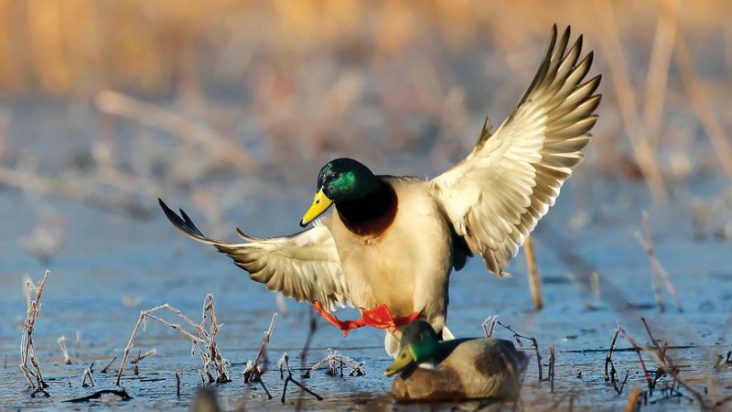
Courtesy Arkansas Game & Fish Commission.
The Arkansas section of the Mississippi Flyway that birds use to migrate across North America is vital for the birds and provides hundreds of millions of dollars in tourist dollars in the Natural State.
Arkansas is in the middle of the flyway that stretches 2,300 miles from the Arctic coast to Argentina. It’s the largest flyway in North America.
State officials have announced that a new $7 million waterfowl research center will be built on the University of Arkansas at Monticello (UAM) campus. An event, co-hosted with the University of Arkansas System Division of Agriculture, marked the creation of the Snowden Waterfowl Center of Excellence and the Dyke-Snowden Endowed Chair of Waterfowl and Wetlands.
The new research center will be part of the Division of Agriculture. A timetable for its construction has not been released.
“All these developments have positioned our campus to be a national leader in waterfowl research, education and outreach. It’s a perfect fit for the state known as the duck hunting capital of the world and the region of that state where a lot of the best of that hunting happens,” said Michael Blazier, professor and dean of the College of Forestry, Agriculture and Natural Resources at UAM.
Funding for the project began during the 2022 Arkansas legislative session when the Division of Agriculture received a $1 million appropriation toward a waterfowl and wetlands endowed chair at UAM. The funds were accompanied by a challenge to raise $1 million in private contributions to complete the $2 million endowment.
David Snowden, Arkansas waterfowl conservationist, and Merritt Dyke, chairman of Dyke Industries, led a group of donors, successfully raising $1 million in private funds for the Dyke-Snowden Endowed Chair of Waterfowl and Wetlands and an additional $5 million in private funds to create the Snowden Waterfowl Center of Excellence.
Last year, Ducks Unlimited also made contributions, which were used to create an endowed professorship in wetlands and waterfowl conservation at UAM.
The Snowden Waterfowl Center of Excellence is a Division of Agriculture research center that will be housed at UAM as part of the Arkansas Forest Resources Center. Directed by Blazier, the Arkansas Forest Resources Center conducts research and extension activities through the Arkansas Agricultural Experiment Station and the Cooperative Extension Service, the University of Arkansas System Division of Agriculture’s research and outreach arms.
Douglas Osborne, professor of wildlife ecology at UAM, will serve as the inaugural director of the center and the Dyke-Snowden Endowed Chair of Waterfowl and Wetland. Blazier noted that Osborne’s 13-year tenure at UAM was instrumental in establishing the center.
Osborne, who is also part of the Division of Agriculture’s experiment station, highlighted how the new center will build on that progress by developing a premier waterfowl program aimed at preparing highly skilled graduates to make a significant impact across the nation.
“To my knowledge, our Snowden Waterfowl Center is the only ‘Center of Excellence’ designated to waterfowl in the country — something that we should be very proud of,” he said. “We’re going to use this for scholarships to recruit students from all over the country.”
Gov. Sarah Sanders noted the economic impact of waterfowl hunting in Arkansas. Hunters contribute more than $300 million each year during the 72 days of the waterfowl season, equating to $4 million daily, which supports communities across the Delta.
“But as you know, duck hunting is much bigger than that,” she said. “For many Arkansas families, a kid’s first duck hunt is a rite of passage. It’s part of our identity. It’s part of the Arkansas story, and this center is coming into being at a time when, unfortunately, that way of life is under threat.
“It’s no secret that waterfowl populations are falling. If we want to ensure that our kids and our grandkids can enjoy the same traditions that we do, we have to make investments today that will help ensure that that happens,” Sanders said.