
AI, satellites used to track, monitor carbon data
by July 28, 2025 10:00 am 501 views
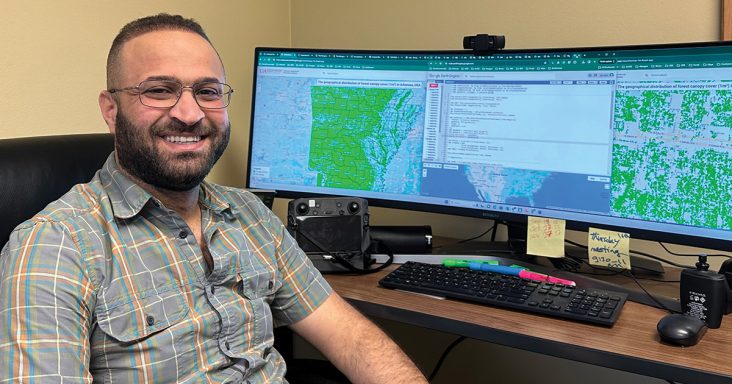
Dr. Hamdi Zurqani, assistant professor of geospatial science for the Arkansas Forest Resources Center and the College of Forestry and the College of Forestry, Agriculture and Natural Resources at the University of Arkansas at Monticello.
Having an accurate estimation for Arkansas’ above ground forest biomass has numerous economic and environmental impacts, Dr. Hamdi Zurqani told Talk Business & Politics. The key is to understand how forests are creating carbon, he said.
Zurqani, an assistant professor of geospatial science for the Arkansas Forest Resources Center and the College of Forestry and the College of Forestry, Agriculture and Natural Resources at the University of Arkansas at Monticello (UAM), has created a technique for data collection that incorporates artificial intelligence (AI) and satellites in space.
The center is headquartered at UAM and conducts research and extension activities through the Arkansas Agricultural Experiment Station and the Cooperative Extension Service, the University of Arkansas System Division of Agriculture’s research and outreach arms.
Archaeologists use satellites to find traces of ancient ruins hidden under dense forest canopies and it also can be used to improve the speed and accuracy to measure how much carbon is retained and released in forests.
“Forests are often called the lungs of our planet, and for good reason,” Zurqani said. “They store roughly 80% of the world’s terrestrial carbon and play a critical role in regulating Earth’s climate.”
At the core of climate change research is understanding the carbon cycle. To measure a forest’s carbon cycle, a calculation of forest aboveground biomass is needed. Though effective, traditional ground-based methods for estimating forest aboveground biomass are labor-intensive, time-consuming and limited in spatial coverage abilities, Zurqani said.
Traditionally, researchers would have to go into the field and measure the trees and other foliage. They would come up with an estimate as to how much biomass was in a given area. It’s time consuming and costs money. Zurqani said he thinks that this method isn’t as precise as the one he’s developed.
“It [his method] is very efficient in terms of time and cost,” he said.
In a study recently published in “Ecological Informatics,” he shows how information from open-access satellites can be integrated on Google Earth Engine with artificial intelligence algorithms to quickly and accurately map large-scale forest above ground biomass, even in remote areas where accessibility is often an issue.
Zurqani’s novel approach uses data from NASA’s Global Ecosystem Dynamics Investigation LiDAR, also known as GEDI LiDAR, which includes three lasers installed on the International Space Station. The system can precisely measure three-dimensional forest canopy height, canopy vertical structure and surface elevation. LiDAR stands for “light detection and ranging” and uses light pulses to measure distance and create 3D models.
Zurqani also used imagery data from the European Space Agency’s collection of Earth observation Copernicus Sentinel satellites — Sentinel-1 and Sentinel-2. Combining the 3D imagery from GEDI and the optical imagery from the Sentinels, Zurqani improved the accuracy of biomass estimations.
The study tested four machine learning algorithms to analyze the data: Gradient tree boosting, random forest, classification and regression trees, or CART, and support vector machine.
Gradient tree boosting achieved the highest accuracy score and the lowest error rates. Random forest came in second, proving reliable but slightly less precise. CART provided reasonable estimates but tended to focus on a smaller subset. The support vector machine algorithm struggled, Zurqani said, highlighting that not all AI models are equally suited for estimating aboveground forest biomass in this study.
The most accurate predictions, Zurqani said, came from combining Sentinel-2 optical data, vegetation indices, topographic features, and canopy height with the GEDI LiDAR dataset serving as the reference input for both training and testing the machine learning models, showing that multi-source data integration is critical for reliable biomass mapping.
Zurqani said accurate forest biomass mapping has implications for better accounting of carbon and improved forest management on a global scale. With more accurate assessments, governments and organizations can more precisely track carbon sequestration and emissions from deforestation to inform policy decisions.
While the study marks a leap forward in measuring aboveground forest biomass, Zurqani said the challenges remaining include the impact weather can have on satellite data. Some regions still lack high-resolution LiDAR coverage. He said future research may explore deeper AI models, such as neural networks, to refine predictions further.
Accurate information like this has several real-world impacts, he said. Timber companies, those companies in the “green” sector, and others can utilize this data, he said. Carbon credit companies, researchers and others can utilize the information. On the state and federal level, it can help policy makers reach better decisions when it comes to forest management and the environment.
On the state level, Zurqani has been able to estimate Arkansas’ forest canopy already, but developing an estimate for the state’s above ground forest biomass will take some time. He hopes to have that work done by the end of the year or early next year, he added.
“My vision is to know the above ground biomass for the state of Arkansas,” he said.
The most impactful area, however, his work will have is in the area of climate change.
“One thing is clear,” Zurqani said. “As climate change intensifies, technology like this will be indispensable in safeguarding our forests and the planet … this process is much easier. The results are very promising.”