
Alice L. Walton School of Medicine opens in Bentonville
by July 20, 2025 12:53 pm 6,220 views
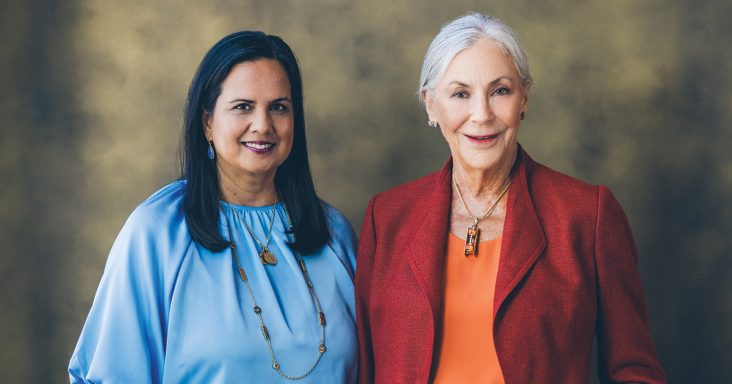
(from left) Dr. Sharmila Makhija is founding dean and CEO of the Alice L. Walton School of Medicine, and Alice Walton
The Alice L. Walton School of Medicine (AWSOM) in Bentonville opened July 14, welcoming its inaugural class of 48 students. The first class graduates in 2029.
Dr. Sharmila Makhija is founding dean and CEO of the school at 1001 N.E. J St. on the 134-acre campus that includes Crystal Bridges Museum of American Art and Heartland Whole Health Institute. She’s been in her role for more than two years.
“Overall, it’s been even better than what I had hoped for,” Makhija said. “Having never started a medical school before, you don’t have a set path figured out. But if you look at all med schools that are opening up, they’re all different missions and visions. Spending the time I did with Alice (Walton) beforehand to hear what she envisioned it to be, making sure it aligned with both of our values, and then recruiting the type of faculty and staff and team has … amplified the work that we want to do.”
Philanthropist Alice Walton founded the school in 2021. The Alice L. Walton School of Medicine offers a four-year medical degree program with a whole-person approach to care. Based on her own health care experiences, Walton recognized the need for a whole-person approach.
“Our state and surrounding regions are medically underserved, and as studies have shown over the past several years, if we don’t take action to address this issue, we’re going to fall further behind,” Walton said. “It’s also essential that we train and support physicians to successfully tackle the health care challenges of the 21st century, including how physicians care for the whole person in order to proactively support well-being and prevent diseases. In states like Arkansas with a large rural population, it’s also essential that physicians learn how to care for patients no matter where they live, including options like virtual care and telemedicine.”
Makhija said part of the school’s aim is “to produce students who know how to think differently and to work in a different way.”
She serves on the Graduate Medical Education Residency Expansion Board and said the school’s graduates will go on to a residency program for subspecialty or primary care training. She said the state needs more of the programs, and AWSOM is working to expand them throughout Arkansas.
“The School of Medicine is poised to be an inspiring learning environment that supports well-being, emphasizes innovation, and equips future physicians to be agents of change,” Walton said. “My goal is that over time we’ll continue to grow the physician pipeline in our region to meet the needs of our community, and we’ll do so with physicians that are trained in whole health, caring for patients’ physical, mental, emotional, and social well-being to promote resilience and prevent disease.”
Makhija is also involved in the work that Walton is investing in with Mercy and Cleveland Clinic. In September, Mercy, Heartland Whole Health Institute and Alice L. Walton Foundation announced a $700 million, 30-year affiliation that includes the Cleveland Clinic, which will contribute its cardiovascular knowledge. As part of the collaboration, the Alice L. Walton Foundation bought a 100-acre site for a proposed health care campus that will include a cardiac care facility. The site is about a mile from the medical school.
 The cardiovascular program will come first, Makhija said. “We’re exploring other areas as to how we expand on that, but we also want that done differently. We don’t want it just to be, ‘OK, you have this problem and you just have this taken care of.’ The preventative, the wellness aspect, pre-, during your treatment, and then post for recovery, so we’re looking at that whole paradigm of how would we want it to be ideally created?”
DESIGN, CONSTRUCTION
Bentonville issued a building permit valued at $47.28 million in August 2023 for the construction of the four-story, 154,000-square-foot Alice L. Walton School of Medicine building. Columbus, Kan.-based Crossland Construction Inc. was the general contractor. Arkansas-based Polk Stanley Wilcox was the lead architect. New York-based Office of Strategy + Design was responsible for landscape design.
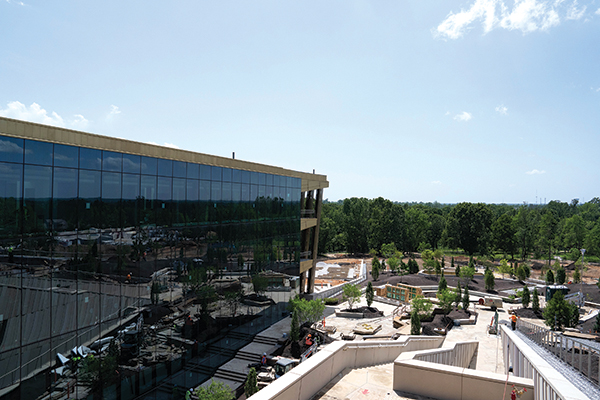
“The building itself is innovative and inviting, designed to welcome students to experience art and architecture as part of their education,” Walton said. “Outside, the building is wrapped in nature, including a 2-acre green roof and gardens surrounding the building. I’m excited about the intersection of all of these elements, and that students, faculty, staff, and the community will be able to experience these spaces and the sense of well-being that comes with spending time in nature.”
Architect Wesley Walls, principal of Polk Stanley Wilcox, said the firm started work on the project in 2021.
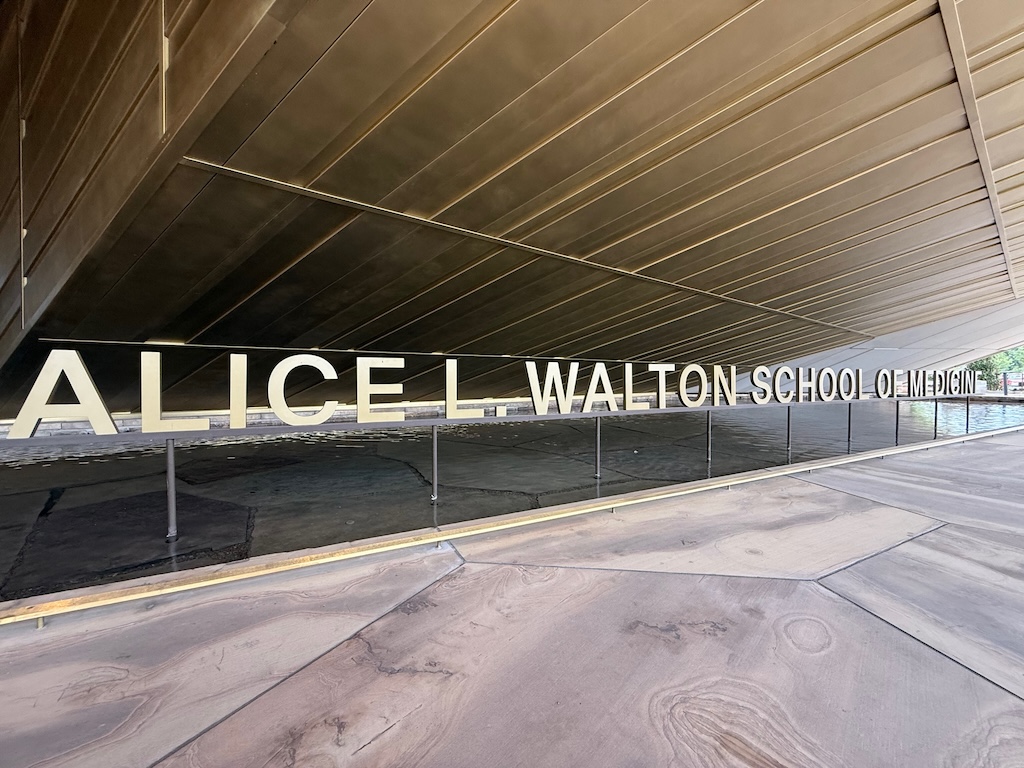
Walls said one of the most unique aspects of the campus is the “intentional blurring of the lines between exterior and interior, between architecture and landscape. The design was as much about the spaces we created outside as it was the inside. One highly visible outcome of this strategy is the building’s intensive, 2-acre green roof system, the largest in the region. But another unique aspect of the abstraction of the regional landscape is the projection of the building out of the site — a cantilevered vein of Ozark ledgestone, forming a protective canopy clad in satin brass and surrounded by reflecting pools. Much like the natural bluff shelters found throughout the region, originally used thousands of years ago as ‘sacred spaces’ for healing, we conceived the building’s entry as a modern-day place of gathering, of shelter, of healing…perhaps even a 21st century sacred space.”
He said one of the school’s key requirements was to “screen the building from the west as viewed from the park and North Forest trails of Crystal Bridges. Our solution involved extruding the building out of the landscape, allowing the park to physically extend onto the roof of the building. This enabled the building to conceal itself to the west, cloaked as a park, while elevating itself to the east towards the community, rising out of the ground as a promontory of contemporary health care education.
“In essence, we considered the whole composition as an abstraction of the regional geology, allowing the building to become an interactive part of the larger Ozark landscape. The campus itself invites the community through the site and onto the building to experience how art, architecture, nature and wellness contribute to improved health outcomes. The west end of the site seamlessly blends trails and landscaping onto the green roof, while the east facade rises out of the ground as an abstracted Ozark bluff shelter, forming a protected entry canopy to the campus from the large community lawn.”
Robert Adams, senior project manager at Crossland Construction, said this was the largest landscaping project he’s worked on in his 27-year career, with about 147,000 plantings on site.
“The building features an 85-foot-long, three-story cantilever with a sloping green roof, which required us to balance that weight with some very complicated engineering that we had to install and then monitor as the building was loaded to make sure the structure was performing as designed,” Adams said. “I believe this project allowed us to showcase our team’s expertise and ability to execute very complex, impactful projects.”
The building is also the heaviest that Crossland Construction has built.
“We self-performed the steel erection on this project, and we are the fifth largest steel erector in the nation by tonnage,” Adams said. “This project is over 1,000 tons heavier than any building we’ve ever done, and we’ve done million-plus square foot buildings.”
Walls said the building, composed of brass, glass and precast concrete, includes learning halls and small group rooms, library, clinical teaching spaces, administrative offices, a student lounge, theater, recreation and wellness areas. The site includes woodland meditation spaces, healing gardens, wetlands, outdoor classrooms, urban farming space, a rooftop park, an indoor/outdoor café, and an amphitheater with an active water feature.
PUBLIC, STUDENT SPACES
Makhija said AWSOM staff want the campus to be accessible to the community and invite people to walk onto the green roof and eventually come into the building. The building will initially be open for students, faculty and staff to allow time for classes to get started.
A private ceremony for students and families is planned this month. A public grand opening ceremony is planned for the end of October, with the first and second floors set to open to the public on Nov. 3. The second floor, accessible from the trail, will house the café, which will also be open to the public.
Visitors can see artwork from Art Bridges Foundation, which is curating the medical school’s artwork and will rotate it every six to nine months. Walton established the foundation in 2017 to expand access to American art nationwide.
The building will also have student-specific amenities such as the lounge, wellness studio and gym. Some might also be available for faculty and staff.
Educational environments comprise the anatomy resource center, clinical teaching spaces, clinic exam rooms, simulation centers and library. The 3,010-square-foot anatomy resource center houses the school’s collection of more than 100 plastinated anatomical specimens, learning tools created from cadaveric donors who have been dissected and then preserved through plastination. The process enables dry, odorless preservation, and the specimens are durable, lasting for decades.
“I think it’s more educational for a student to see what it really looks like,” Makhija said. “To have that investment from Alice to do it as a state-of-the-art … you don’t see many schools that can do that. I also foresee that when we are working with the community doctors to be able to help them if they need any refinement of looking at certain models. The simulation is also another layer of this, combining it with virtual reality that brings us to a whole other level of education opportunities and a lot more refinement.”
STUDENT DEMOGRAPHICS
The first AWSOM class comprises about one-third Arkansans, nearly one-quarter are from states bordering Arkansas and the remainder are from the rest of the United States. About 15% have a rural background. Makhija said this is important because less than 5% of U.S. medical students have a rural background.
“We wanted to increase that because we do know the needs of the state are in the rural areas,” she said. “And if you are from a rural background, you’re more likely to understand and relate.”
AWSOM is waiving tuition for its first five classes of students. The first four classes will comprise 48 students per class. After achieving full accreditation, the school can increase class sizes, but she said the school will start to “slowly increase” the class size after that.
Across from the medical school will be a five-story, 300-unit apartment complex. The 11-acre complex at 1100 and 1102 N.E. J. St. will include two buildings, one for medical students and the other for area residents. The units will range from studio to two-bedroom apartments. Construction of the 300,000-square-foot apartment complex is expected to take about two years.
While it’s under construction, AWSOM has secured housing for students across the city, including in the four-story, 622-unit Crystal Flats development, located southeast of the medical school.
‘BUILD THEIR COURAGE’
Makhija said building the medical school’s teams has been one of the best parts of her job. This has included understanding people’s mission and vision and ensuring that it aligns.
“We have a leadership team that we’ve built out that are hands-on, not just sitting back in their office and thinking, ‘OK, just do this because I say to,’” she said. “We’re very engaged.”
She said this has been “as close to being an entrepreneur as I’m ever going to be because I don’t know if I could build a company. I’ve always gone into an established academic center, try to work as best as we could with … the teams that we had. You can maybe add a person here or there, but to build them from scratch and help the ground teams grow and move, that’s taken a lot of energy and thought. And we find joy in that.”
She said difficult situations bring together people who are aligned and open to speak.
“We don’t want them to just drink the Kool-Aid and do exactly what we say,” Makhija said. “We want them to bring to us the problems and what they think are the solutions, and they’re right usually all the time.”
She said one of the most challenging aspects of establishing a new medical school has been to tell faculty and staff that she won’t give them her opinion and allow them to figure out the solution on their own.
“What I’m trying to do is help them build their courage or their bandwidth or … their feeling of how to get something done,” she added. “It’s hard because I see it from their point of view, too. They don’t want to mess up … And believe me, it is not easy. We have to be pretty accurate on many things, but there’s areas of creativity and … things that allow that movement of not necessarily having to be one particular way.”
ONGOING ACCREDITATION
This past fall, AWSOM secured preliminary accreditation from the Liaison Committee on Medical Education, allowing the school to begin recruiting students. The Liaison Committee on Medical Education is recognized by the U.S. Department of Education and serves as the accrediting body for allopathic medical schools in the United States.
Makhija said this accreditation is ongoing. The Liaison Committee on Medical Education is set to visit AWSOM again in 2027 “to see how we’re doing — that what we said we’re doing, we’re actually doing,” she said. “This also includes surveying the students.”
Before the first class graduates in 2029, the accrediting body completes a “full accreditation review,” she said. “After our first class graduates, then we’re eligible to get full accreditation.”
The accrediting body will then revisit AWSOM every two years, as it does with all other medical schools. The Higher Learning Commission is the school’s national accreditor and will review its governance and fiduciary responsibility. The school will submit paperwork to this accreditor in July, allowing students to receive federal funding if they require support for loans.
Also in fall 2024, the Arkansas Higher Education Coordinating Board certified the school’s medical degree program.
EDUCATION FOCUS
Makhija said the educators’ primary job is to teach. This is unique from other medical schools’ educators, who might also run a lab to support their salaries. This has been a concern for medical schools facing funding cuts.
Still, if AWSOM’s educators want to do research, “that’s fine,’ Makhija said. “But their salaries, their livelihood, are not dependent on that. So that’s very different because we are very hyper-focused on how we teach.
“The curriculum itself … it’s called ARCHES. And because we’re sitting on the campus of Crystal Bridges, we’re taking educators out of Crystal Bridges to work with our educators to teach art … We have built in what we call the thread of the art of healing into all the cases all throughout the four years.”
She said the art of healing helps students become better at empathy, clinical determination and communication skills “because you have to verbalize what you’re seeing.”
Embracing whole health also makes the school unique, she said. Whole health principles comprise the school’s foundation, “which if you look longitudinally, is the basis for value-based care.” This includes looking at patient health outcomes instead of a “fee-for-service — looking at one interaction, and that’s it to take care of a problem. So we’re incorporating preventive health and wellness for our faculty, staff, and students so that they can teach it.”
She said the healing and teaching gardens on campus will be incorporated into student education.
AWSOM will also offer a modified version of health system sciences, which is a American Medical Association track that many schools don’t use. This includes how to work in a health system infrastructure, how to help improve it, how things are paid for, what Medicaid is, leadership and the business of medicine. She said students need to know about this after medical school, but this is often not taught.
She and Brent Williams, dean of the Sam M. Walton College of Business at the University of Arkansas, will co-teach a leadership course in the health system science track. Before Makhija joined the medical school in 2023, she served as the department chair of obstetrics, gynecology, and women’s health at Albert Einstein College of Medicine and Montefiore Health System in the Bronx, N.Y. She worked there for about eight years and taught business of medicine.
She said AWSOM will likely invite other UA faculty to teach at the medical school.
Medical schools typically offer students clinical rotations in their third or fourth year; however, based on her experience, students often leave medical school with only a short period of experience in understanding clinical aspects. Students learn about it but don’t practice it in the first two years. AWSOM maintains the third and fourth years unchanged, but students will begin to receive early clinical experience within the first two months of their first year.
“They will be in the classroom, they will practice in simulation, and then they go into what we call the ECE, the early clinical experience,” she said. “Mercy is our educational partner. We are allocating one of their leaders as the leader of this course, so she’s teaching. And then her team will take the students into their clinics, and they will be practicing and learning value-based care in real time.”
AWSOM has 100 faculty and staff.