
Fractional marketing firms provide part-time C-suite services

Two longtime marketing executives are successfully betting that if a small to medium-sized business doesn’t need or can’t afford a full-time chief marketing officer, it can still use a fraction of one.
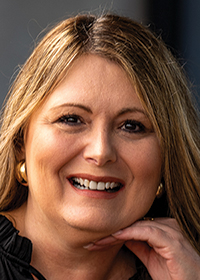
Rogers-based Kyle Proctor, a 10-year veteran at Arvest Bank with 25 years of total marketing experience, founded his company, Yellow Nunchucks, in 2024. Fayetteville-based Annette King founded BrandWorks Marketing Lab last year after more than 20 years at First Security Bank, most recently as senior vice president, marketing.
The two say they are part of a trend known as fractional marketing, where professionals provide their experience to multiple clients, giving each a healthy fraction of their time.
They say it differs from consulting or freelance work because it’s senior level and strategic, rather than project-based. They serve as a client’s fully engaged chief marketing officer (CMO) who is integrated into a company’s leadership. A fractional CMO can set budgets, measure key performance indicators, and manage people and vendors.
“I believe that someone that’s in a fractional role really works more as a strategic partner that is embedded in the business,” King said. “They’re helping set direction, guide decisions, ensure that the marketing supports the long-term goals of the company. They know the ins and outs of that company in order to be able to market it the best way possible in the voice and tone and using the right messaging pillars for that particular company.”
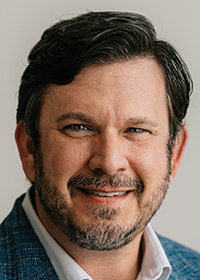
Proctor said that, from the clients’ perspectives, the fractional CMO model lets firms work with a professional without having to pay a full-time salary or benefits. Instead, companies can write him off as a business expense.
“They’re not paying for health care, 401(k)s and other fees associated with somebody,” he said. “They’re paying for somebody to come in and get the job done.”
He believes the model will become more common as companies reorganize and seek to become more efficient. He’s also seeing fractional chief financial officers and chief operating officers.
A NEW VENTURE
Proctor previously served as Arvest Bank’s director of public relations and social media before starting Yellow Nunchucks. He started thinking in 2023 about how he would open his own firm. He was ready for something different and a varied set of clients. He filed with the secretary of state’s office and began working nights and weekends on his new venture. His first client was Buffalo River Aviation. He left Arvest Bank to operate the company full time about a year ago.
“I made lots of relationships with people in the industry throughout those roughly 25 years,” he said. “So I had a pretty big Rolodex to pick from, or contact list to pick from, if I needed somebody to do something. I started thinking about, ‘OK, well, how would consulting, how would a fractional CMO position work?’”
Proctor’s company name comes from a set of toy nunchucks, a two-handed fighting instrument, that he and his dad, the late Judge Rick Proctor, fashioned from a broom handle while Proctor was growing up in his hometown of Wynne. In late 2022, his sister approached him with what she called a “Christmas present” — the yellow nunchucks.
“I thought about the relationship with my dad,” he said. “I thought about the imagination behind the nunchucks and me playing with them. … We made them for cheap, and my dad was very intentional about it, because I’d asked for the real set, like the heavy ball bearing stuff. So I guess I thought about that and I thought, you know, it’s a unique name. I can bring a lot of those traits to my clients. I can bring creativity. I can bring efficiency. I can bring ingenuity, intentionality, visibility.”
Proctor said the first quarter of 2025 was challenging as potential clients seemed reluctant to make a move in an uncertain political and economic environment. But his mentors told him to be patient, and he missed by only one month his goal of earning an income equal to his corporate salary within six months.
Proctor usually works on three-, six- and 12-month retainers, in some cases in an exclusive relationship in a particular industry. Clients include Stone Bank, with which he works as a consultant; Mountain View-based Urban Forge, which produces forged steel furniture; The 808 Ranch, a beef cattle company; Apex Ag Solutions, a row crop company; and California-based Iconic Guitars.
ON HER OWN
For King, this is her second time to own a marketing firm. After college, she worked for First Security Bank and then owned a marketing consulting business in the Dallas-Fort Worth area where she worked with finance, small business and professional services companies.
The opportunity arose to move back to Arkansas and return to First Security Bank. During her long stint there, she worked alongside small businesses and nonprofits and was struck by the northwest region’s startup energy, as well as the need that many companies had for senior level marketing leadership. Last year, the timing was right to move out on her own.
“It wasn’t a reinvention of myself but more of a reconnection,” she said. “It was going to allow me to partner more closely with businesses, solving problems and building strategy. The fractional label is new, but that work is not new to me. Entrepreneurship has always tugged at my heart.”
She received her business license last June and spent the third quarter building systems, developing processes and establishing partnerships. She formally launched in October. She works as a fractional CMO for banks and finance-based businesses while typically offering more project-based consulting services for small businesses. She’s also a Realtor.
“I guess when any entrepreneur starts, there’s a lot of uncertainty when you step out on your own,” she said. “And, you know, I had that. But I also had decades of relationships and experience and business connections. And I knew the value that I could bring to people who needed some marketing direction. I didn’t have everything perfectly lined up. I would say today I still don’t have everything perfectly lined up. I trusted my business plan and my marketing plan, and I leaned into the demand that I knew that was here in Northwest Arkansas for fractional marketing. And, I guess, like most entrepreneurs, you stand on a great foundation, and you move forward while you’re figuring things out. And that’s kind of where I am right now.”
Clients include an author, an enrichment learning community, a medical spa and an Alma food truck. With the latter, she’s created a brand identity and labeling for the business’s barbecue sauce. She’s also connected the operator with a local nonprofit organization that receives a portion of the food truck’s profits.
In many ways, it’s not so different than marketing a bank. It’s about defining a company’s mission and core values, finding the target audience, and determining what to say to that audience.
“It’s about relationships,” she said. “It’s developing those relationships and finding out what your unique value proposition is and communicating it well. And so you’re using the same tactics as you would in the banking environment. You’re just using it for a different industry.”