
Casqui village, De Soto research continues near Parkin in Cross County
by December 28, 2025 10:00 am 563 views
When explorer Hernando De Soto arrived in the Native American village of Casqui in 1541, the villagers had a serious problem. Drought had plagued them, and their chief, also named Casqui, asked them to pray to their God for rain.
A Catholic, De Soto ordered his men to place a cross atop the chieftain’s mound, an artificial earthwork constructed by the Native Americans that abutted the St. Francis River near the modern-day town of Parkin in Cross County. The explorer and his men prayed. The next day it rained, according to journals kept by the men on the expedition.
It was reportedly the first time Europeans had contact with Native Americans who lived in Arkansas, Parkin Archeological State Park Superintendent Nathan Odom told Talk Business & Politics.
Pieces of a wooden post made from a bald cypress tree unearthed at the spot where the cross should have been erected are displayed in the museum on the site. The wood fragments come from a tree that De Soto and his men used often, and carbon dating aligns with the 1541 date, Odom said.
Explorer Luys Hernando de Biedma wrote in his journal at the time, “On the summit of the mound we drove in the cross and we all with much devotion, kneeling to kiss the foot of the cross. The Indians did as they saw us do, neither more nor less.”
The Caqui village existed from about 1000 A.D. to about 1600 A.D., Odom said. It’s believed people inhabited the area, which sits at the confluence of the St. Francis and Tyronza rivers, much earlier than that, but not enough archeological evidence has been uncovered to prove it. The village at Parkin was the capital of the Natives who lived in that region, and there could have been as many as 25 other villages along waterways in the region.
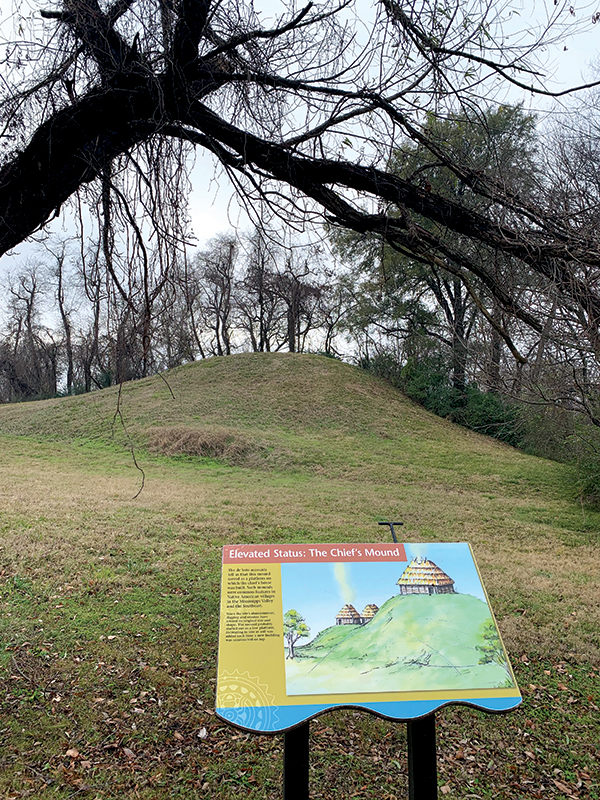
At its peak, about 2,000 people lived in the village, according to archeologists. The main mound was the center of the village, and the chief reportedly lived on top of it. Below the mound was a plaza where ceremonies, festivals, and other public events would be held.
Other prominent people in the tribe likely lived close to the mound, while others lived farther away. The mound was surrounded by a moat that was 85 feet wide and 7 feet deep.
Houses in the village were built on smaller mounds and were made of clay and river straw. The Natives that inhabited this area were part of Mississippi Mound Culture, an epoch in Native American history when tribes formed tight societies and built large mounds along the Mississippi River and its tributaries.
These societies had vast trading networks and were known to grow large quantities of crops including corn, beans, and squash. At Parkin, shells from the Gulf Coast have been discovered along with copper artifacts that came from the Great Lakes region. Access to the river system, fertile soil and plentiful game made the Parkin area a viable place to live, Odom said.
There have been numerous excavations of the site starting in 1879, and then later in the 1960s and 1990s. Clay floors from the houses have been unearthed, along with a myriad of pottery, arrowheads, effigy pots, and other remnants of that civilization.
Archeologist Dr. Robert Scott said there is no evidence of a defensive wall around the village. One of the most unique artifacts found was a Mississippi gorget, an ornament that was worn around the neck. Many of the displayed pieces that people see in museums are burial pieces or ceremonial pieces that were not worn, but the gorget, shaped like a spider and referred to as a Spider gorget, was worn.
Relic hunters often looted the site, and some of the best pieces in the museum came from local families’ collections, Odom said. Visitors to the park can see many of the pieces in the museum, and it includes an interactive room with replica pelts and other implements common to the era, including a Spanish helmet and suit or armor that can be worn.
The mound still exists near the river, and outlines of the moat and other features of the village still exist. Why the village ceased to exist around 1600 A.D. is a mystery.
“We don’t know why they left,” Odom said.
War, disease, drought, or other factors could have forced the Natives to leave the village. De Soto was a disruptive presence in the region, and that could have been a factor.
Casqui gave De Soto 5,000 warriors, and it’s believed that this combined army may have clashed with another group of Natives living near the modern-day town of Wilson in Mississippi County. De Soto and his men also raided Native food supplies and if the drought was as bad as reported, that might have put even more pressure on their fragile society, Odom said.
The single best evidence that this is the spot where De Soto landed, besides the spot on journal entries of his men, was a single Chevron glass bead that was found at the site. It’s the only bead associated with De Soto that’s ever been found in Arkansas, Odom said.
Scott said archeologists hope to solve several mysteries at the site.
“Was there a defensive wall here? Did the layout [of the village] change through the years?” he said.
Creating an artifact chronology and another remote sensing survey could help answer those questions, and those are future objectives, he added.
Many people in the region and around the state have no idea about the rich history at Parkin, Odom said. It’s one of the most historic spots in the entire state.
“I love telling this story,” he said.