
Walmart net income up 56.1%, revenue up 3.7%
by August 21, 2025 12:30 pm 1,504 views
Second quarter net income for Walmart was $7.026 billion, up 56.1% compared with the same period in 2024. Per share earnings were 88 cents before adjustments reduced them to 68 cents, below the consensus estimate of 74 cents.
The adjustments related to restructuring costs in Walmart’s corporate headcount and at Sam’s Club, and higher general liability and workers’ compensation claims.
Revenue, which includes sales and membership income, increased 3.7% to $175.75 billion in the fiscal quarter ended July 31. E-commerce sales jumped 25% globally and rose 26% in the large U.S. business. Global advertising revenue increased 46% year over year, including the Vizio business. The U.S. advertising business grew 31% from a year ago.
Walmart’s operating income totaled $7.286 billion, down 8.2% from a year ago amid higher administrative expenses, cost of goods, and interest costs.
“The top-line momentum we have in our business comes from how we are innovating and executing. Connecting with our customers and members through digital experiences is helping to drive our business, and the way we’re deploying AI will make these experiences even better,” CEO Doug McMillon noted in Thursday’s (Aug. 21) report.
Walmart raised its guidance and outlook, led by the growing profitability in the online business. The retail behemoth expects third-quarter sales growth between 3.75% to 4.75% with operating income gains between 3% to 6%. Adjusted earnings per share are pegged at 58 cents to 60 cents.
For the full year, Walmart now expects net sales growth between 3.75% to 4.75%, and it raised adjusted earnings per share estimates to range between $2.52 and $2.62 for the year ending Feb. 1.
WALMART US
Consumers spent more online and paid extra for delivery, which helped to push Walmart U.S. sales and profits higher in the quarter, according to the report. Sales totaled $120.9 billion in the quarter, up 4.8%. Comp sales, excluding fuel, rose 4.6% with average ticket size increasing 3.1%. The retailer reported a 1.5% gain in store traffic.
The e-commerce business, up 26% in the quarter, comprised 4.2% of Walmart’s comp sales in the quarter.
Sales of general merchandise, items outside of the grocery department, were a bright spot for Walmart in the quarter, said Walmart Chief Financial Officer John David Rainey. This reversed a trend of decreased discretionary spending because of escalating food costs.
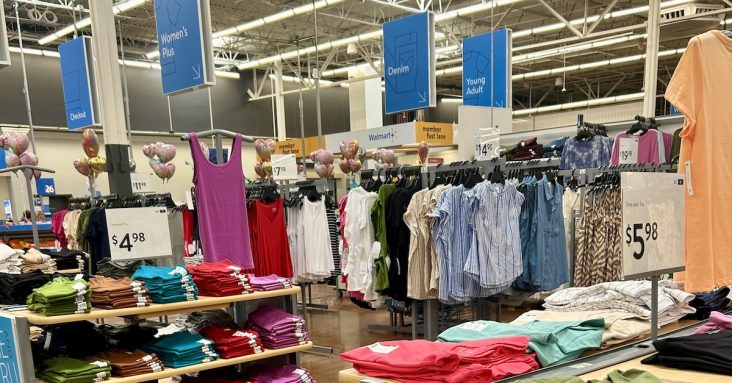
Comparable sales for general merchandise rose by a low-single-digit percentage and accelerated throughout the quarter, Rainey said. He said clothing and fashion sales “really shined for us.”
The segment reported operating income of $6.7 billion, up 2% from a year ago. and advertising revenue grew 31%. Inventory increased 2.2%, and McMillon said the retailer is maintaining healthy in-stock levels.
TARIFF IMPACT
On pressures from Trump tariffs, Rainey said “we’re doing what we said we would do. We’re keeping our prices as low as we can for as long as we can. Our merchants have been creative and acted with urgency to avoid what would have been additional pressure for our customers and members.”
He said the merchants have done a terrific job managing pricing and mix across merchandise categories.
“We aren’t seeing dramatic shifts the way things have played out so far. The impact of tariffs has been gradual enough that any behavioral adjustments by the customer have been somewhat muted,” Rainey said.
He said Walmart is seeing post-tariff price levels increase each week as it replenishes inventory, and that is expected to continue through the rest of the year.
“Not surprisingly, we see more adjustments in middle and lower income households than we do in higher-income households. In discretionary categories where item prices have gone up, we see a corresponding moderation in units at the item level, as customers switch to other items, or in some cases, categories. As always, our customers are aware, smart and value-conscious,” Rainey said.
SAM’S CLUB
With net sales of $23.6 billion, Sam’s Club put up steady results. Excluding fuel, sales totaled $21.2 billion, up 6% year over year. Comp sales, without fuel, rose 5.9% amid transaction growth of 3.9% and average ticket gains of 2%. E-commerce contributed 3.5% of the total comp.
Operating income totaled $500 million, down 15.8% before adjustments of $80 million from supply chain reorganization charges. Adjusted operating income totaled $600 million, down 2.1% year over year. Membership income grew 7.6% with increases in member counts and renewal rates.
Sam’s Club CEO Chris Nicolas said in the past quarter 50 new brands were added, such as Express and Vera Bradley, which are not typically sold at Sam’s Club. He said this is lifting general merchandise sales and helping the overall margin and mix of the club business.
WALMART INTERNATIONAL
The international business reported net sales of $31.2 billion, up 5.5%. On a constant currency basis, sales totaled $32.7 billion, a gain of 10.5%. Currency fluctuations negatively impacted sales by $1.5 billion in the quarter.
Operating income totaled $1.2 billion, with strength from China, Walmex and Flipkart. Operating income on a constant-currency basis was $1.3 billion, down 2.8% year over year due to investments made in India, Canada, and Mexico.
Advertising revenue in the segment grew 15%, led by Flipkart. E-commerce sales rose 22%, led by store fulfillment, pickup and delivery and a growing marketplace digital mix across markets.
Walmart shares (NYSE: WMT) traded lower at $98.32 around mid-morning on Thursday, falling 4.15% from the prior-day close in heavy trading. Over the past 52 weeks, the shares have traded between $75.01 and $105.30. Year to date, the share price is up 8.51%.